
Press releases
Lea Camenisch joins the Executive Management Board
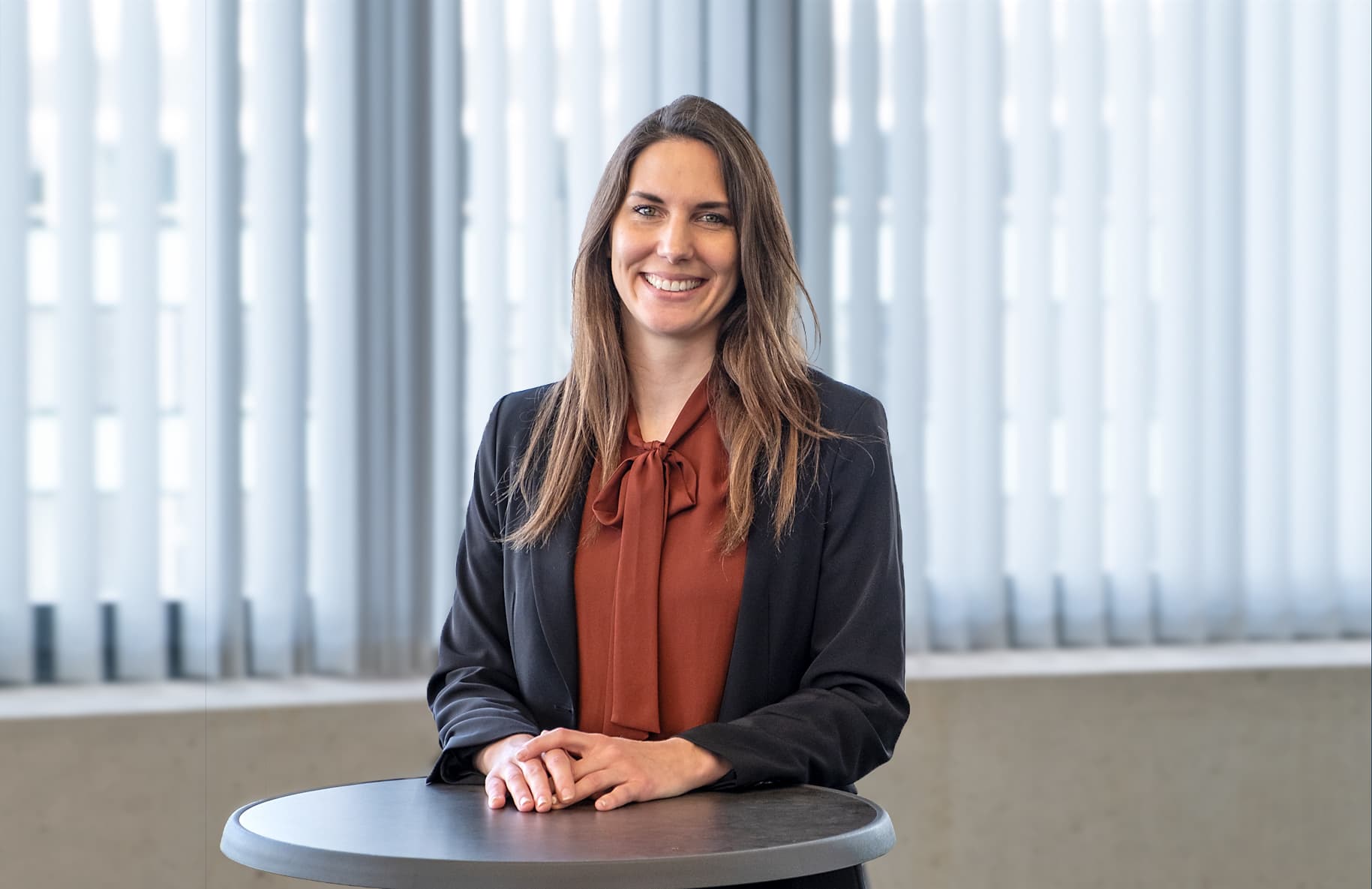
As Group CFO and member of the executive management team, Lea Camenisch brings a new perspective to corporate leadership – positioning finance as a strategic compass and a driving force for long-term sustainability and future readiness.
In a market shaped by regulatory dynamism, technological advancement and rising client expectations, one factor is becoming increasingly critical: financial stability as the foundation for long-term investment, reliable partnerships and sustainable growth.
In this interview, Lea Camenisch – who has been with Profidata for the past two years – discusses her leadership approach as Group CFO and reflects on international collaboration within the company. She also outlines the advantages of a privately owned organisation and shares her perspective on the forward-looking role of finance and controlling.
Lea, you have been serving as Group CFO and member of the executive management team since January 2026. What does this mean for our clients?
For our clients, it is of paramount importance that we are financially sound. A stable economic foundation enables us to invest for the long term in new products, emerging technologies, security, quality and, above all, in our people. Particularly in our industry, the principle holds true: those who do not actively shape innovation and continuous development risk losing their competitive edge.
Which strategic priorities are associated with your role?
One of my core responsibilities is to sharpen our forward-looking perspective: to establish control mechanisms that allow us to identify risks at an early stage, steer investments in a targeted manner and plan strategically. Today, the finance function is no longer merely a “rear-view mirror”; it operates with a distinctly future-oriented mindset.
At Profidata, I also see considerable potential to further digitalise processes and align them with modern standards – developments that ultimately benefit our clients as well. As a privately owned company, we enjoy a greater degree of independence than many of our competitors, which gives us a decisive advantage. This is reflected not only in our financial performance, but also in our ability to deliver reliably, execute on our roadmaps and avoid reactive decision-making in response to every market movement.
You emphasise the advantages of being a privately owned company. Why do you see this as a compelling argument – also from a client perspective?
Because it fosters trust. We do not have external investors in the background demanding the highest possible EBITDA margin within a short timeframe or steering decisions purely on return-driven considerations. This allows us to think and act with a long-term horizon and to consistently reinvest profits into the business – particularly when it is strategically sound to do so. This philosophy is deeply embedded in Profidata’s DNA.
Our company founder, Christian Widmer, repeatedly underscores that sustainable progress is only possible through continuous investment. For our clients, this sends a clear signal: Profidata remains stable, reliable and future-ready because our strategic decisions are not dictated by short-term return targets. At the same time, we must ensure that we are financially robust, safeguard our capacity to invest and manage it with foresight and discipline.
What specific advantages does the privately owned structure offer in your role as CFO?
Above all, the short decision-making paths are far from commonplace in this form. The owner places considerable trust in the executive management team and has known our CEO, Roger Wildi, for more than 30 years. This ensures that internal communication remains swift and efficient, as not every detail has to pass through multiple layers of approval.
In addition, there is a clearly defined succession plan. With our Group CEO, Marc Widmer, continuity is assured – significantly reducing the risk of a sudden strategic realignment or sale of the company. For our clients, this level of predictability and stability is a genuine advantage.
In your opinion, what is essential to ensure that growth at Profidata remains sustainable?
This brings us back to Profidata’s core philosophy: growth is important, but not at any price. It is not about becoming as large as possible in the shortest possible time, nor about expanding purely through a presence in as many countries as possible. We first analyse carefully what makes sense – strategically, organisationally and culturally. This also applies to the development of our international subsidiaries.
At times, growth is talent-driven rather than client-driven, because competencies form the long-term foundation for entering new markets. In other cases, we assess where client-side potential lies and build from there. In my view, the decisive factor is the combination of thorough analysis and the courage to act. You need the financial latitude to invest boldly in a new market. Initially, costs arise and scenarios can be modelled, yet there is no guaranteed return on investment. Even so, taking that step can be strategically right. I would say that Profidata is prepared to be bold in this respect – and that is critically important.
What role does corporate culture play for you as CFO?
In the past, corporate culture was often viewed primarily as an HR topic. Today, it is equally clear within finance that a positive working environment has a direct impact on quality, collaboration and long-term success – even if this cannot always be measured in purely quantitative terms. In my view, it is more important than ever to foster close connections across departments.
An open corporate culture is essential to me. The more transparent the exchange, the earlier we identify risks and opportunities. When finance is involved at an early stage, we can do more than provide figures – we can offer guidance, both operationally and strategically.
"When finance is involved at an early stage, we can do more than provide figures – we can offer guidance, both operationally and strategically."
Could you elaborate on that?
Profidata makes a conscious investment in its corporate culture – through events and team-building initiatives such as our Proficamp, but also through principles that are actively lived in day-to-day business. One example is that the majority of our employees work primarily from the office. This fosters personal encounters, builds trust and enables conversations that would rarely take place in purely digital meetings – whether in the corridor or the cafeteria. It creates a strong cross-functional exchange that, in my view, works exceptionally well at Profidata.
As a result, challenges are identified much earlier and can be addressed proactively: an idea can be shared, a solution proposed, support offered before an issue becomes critical. I experienced this particularly during the coronavirus pandemic in my previous role. The small, informal interactions disappeared, and it was often impossible to intervene at an early stage because challenges developed beneath the surface. By the time they became visible, they were frequently far more significant.
What do you experience at Profidata as particularly cross-functional – do you have concrete examples?
Within the executive management team, a range of perspectives is represented, from Development to Finance. This enables us to connect functions more effectively, frame topics differently and assess structural matters within a broader overall context. A very tangible example from everyday life – and one I personally find genuinely inspiring – is our weekly sports sessions. Colleagues from different departments come together, entirely independent of function or hierarchy. Of course, conversations revolve around training goals and personal interests, but they also naturally extend to business topics. It is precisely this informal setting that lowers the threshold for approaching colleagues from other areas and fosters a culture of open exchange.
The Profidata Group has offices in six countries. What are your priorities at Group level?
My aim is to further harmonise financial structures across the Group and enhance the efficiency of our processes. Through clear guidelines and transparent dialogue with our subsidiaries – abraxas, itechx and Arkus – we create a high degree of transparency and comparability in our figures. This not only saves considerable time, but also improves the quality of exchange. When reviewing financial data, I can more quickly understand what it signifies and provide more targeted, meaningful feedback.
What role do automation and AI play in this context?
We are continuously working to further automate our internal processes and align them with modern standards. Yes, we are also closely monitoring AI-based innovations. Automation creates capacity by reducing repetitive tasks. The time gained can then be invested in analysis, steering activities and strategic initiatives.
Ultimately, it is about simplifying processes and establishing a robust data foundation that enables meaningful analysis, allowing the executive management team and the Board of Directors to make well-informed decisions more quickly. With several international subsidiaries reporting separately, standardisation becomes a key driver of speed and clarity.
The Group intends to continue growing. What are the greatest challenges?
Beyond the economic challenges, some of our structures have evolved historically. This means we must ensure that our organisational setup is designed in such a way that growth does not generate unnecessary administrative complexity. Another major topic is culture. Across different locations, countries, cultures and legal frameworks, personal interaction naturally becomes less frequent. Nevertheless, we want to ensure that our teams abroad truly experience our corporate culture – that employees feel valued and recognise that each individual matters. This is undoubtedly demanding, but it is achievable – particularly because Profidata does not pursue growth at any cost.
How would you describe your leadership style?
Mutual appreciation and trust are at the core of my approach. I do not believe in micromanagement; rather, I aim to give my colleagues as much autonomy as possible. At the same time, it is important to me to lead in an individualised way. Some people thrive on clear structures and defined parameters in order to feel secure. Others prefer greater freedom and set their own processes and boundaries. I try to recognise these differences and support each team member in the way that suits them best.
Another key element is open dialogue. My team is already well connected, yet I actively encourage relevant topics to be raised in our regular meetings. It is about addressing challenges transparently and discussing solutions collectively. In doing so, we seek to avoid the classic silo mentality – or, as we might say in Switzerland, a “Gärtlidenken” mindset.
How do you personally remain clear-headed and focused during demanding phases?
Probably not in the way one might expect from a CFO. Being extremely rigid, meticulously prioritising every task, enforcing strict focus blocks and eliminating all interruptions – that is not my approach. What matters most to me is clearing my head from time to time and then returning to my desk with renewed focus. That might mean having a coffee with colleagues or going for a longer run at lunchtime or in the evening. Sport, in particular, helps enormously when you can no longer see the wood for the trees.
Of course, I work with deadlines and defined structures. But when things become particularly intense, humour is my most effective tool: sharing a genuine laugh, pressing reset for a moment, taking a breath and then approaching solutions with fresh perspective.
And outside of work: what gives you energy, what matters most to you in your free time?
Sport is an important counterbalance for me – whether fitness training, kickboxing or running. In summer, I am naturally drawn to the mountains. At the same time, I need creativity as a contrast to my professional responsibilities. I work artistically with concrete, wood, resin or acrylic paints. It gives me a great deal because I can create entirely without constraints or predefined objectives. And I have a genuine love of good food. My favourite moments are meeting friends for brunch or enjoying a long dinner together – sharing a meal, exchanging ideas and simply savouring the moment. For me, that is true quality of life.
Finally, is there a message that is particularly important to you – something we should take away from this conversation?
Many companies still underestimate the transformation taking place within the finance function. Finance is no longer confined to reviewing the past; it looks ahead, supports strategic direction and delivers strategy-based analyses that enable objectives not only to be formulated, but actively pursued. It is about making strengths and weaknesses visible across departments, improving together and maintaining – or, where necessary, adjusting – the right course. As Group CFO, I see finance as a living, dynamic function that belongs at the heart of the organisation. When approached thoughtfully, it creates a powerful interplay between stability, collaboration and flexibility. That is what makes Profidata strong – and future-ready.
Would you like to learn more about Profidata?
We would be delighted to speak with you. Our team will be pleased to answer your questions and demonstrate how our solutions and services can help you optimise your processes.
Book a consultation